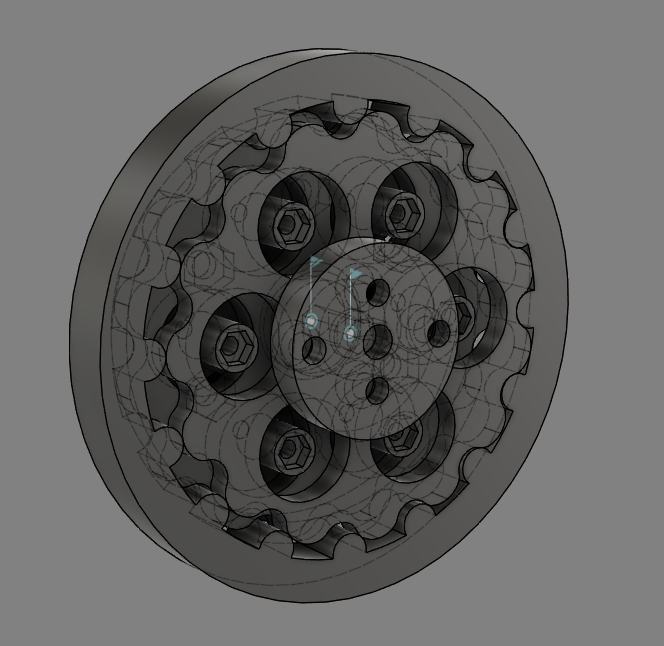
# MAD Cycloidal Actuator

## New Method (Updated 2023-09-30)

```python
# generate_cycloidal_profile.py
import numpy as np
import matplotlib.pyplot as plt
import ezdxf


def generateCycloidalGearProfile(r_housing=36, r_roller=4, N=16, eccentricity=2):
    theta = np.arange(0, 2*np.pi, 0.001)

    psi = - np.arctan(np.sin((1 - N) * theta) / (r_housing / (eccentricity * N) - np.cos((1 - N)*theta)))

    x = r_housing * np.cos(theta) - r_roller * np.cos(theta - psi) - eccentricity * np.cos(N * theta)
    y = -r_housing * np.sin(theta) + r_roller * np.sin(theta - psi) + eccentricity * np.sin(N * theta)

    return np.concatenate(([x], [y]), axis=0)


def writeDXF(filename, fit_points, ref_circle_radius=10):
    doc = ezdxf.new("R2010") # create a new DXF drawing in R2010 fromat 
    msp = doc.modelspace()

    fit_points = fit_points.T.tolist()

    start_point = fit_points[0]

    # close the loop
    fit_points.append(start_point)

    spline = msp.add_spline(fit_points)

    spline.set_closed([(start_point[0], start_point[1], 0)])

    print(spline.dxf.n_fit_points)

    circle = msp.add_circle((0, 0), radius=ref_circle_radius)
    
    doc.saveas(filename)

# 5010

fit_points = generateCycloidalGearProfile(
    r_housing=29.,
    r_roller=2.5,
    N=16.,
    eccentricity=1.25
    )
'''
#fit_points_ = generateCycloidalGearProfile(
#    r_housing=29.,
#    r_roller=3.,
#    N=16.,
#    eccentricity=1.25
#    )

'''
# M6C12
'''
fit_points = generateCycloidalGearProfile(
    r_housing=36,
    r_roller=4,
    N=16,
    eccentricity=2
    )
'''
print(fit_points.shape)

x, y = fit_points
#x_, y_ = fit_points_
plt.plot(x, y)
#plt.plot(x_, y_)
plt.show()

writeDXF("cycloidal_profile.dxf", fit_points, ref_circle_radius=31)

```

### RI-60 Parameters

<table><thead><tr><th width="340.3333333333333"></th><th></th><th></th></tr></thead><tbody><tr><td>Housing Radius</td><td>29</td><td>mm</td></tr><tr><td>Housing Roller Diameter</td><td>5</td><td>mm</td></tr><tr><td>Central Hole Diameter</td><td>18</td><td>mm</td></tr><tr><td>Side Hole Diameter</td><td>13</td><td>mm</td></tr><tr><td>Eccentricity</td><td>1.25</td><td>mm</td></tr><tr><td>Spacing Radius of Side Hole</td><td>17</td><td>mm</td></tr></tbody></table>

### RI-70 Parameters

<table><thead><tr><th width="340.3333333333333"></th><th></th><th></th></tr></thead><tbody><tr><td>Housing Radius</td><td>36</td><td>mm</td></tr><tr><td>Housing Roller Diameter</td><td>8</td><td>mm</td></tr><tr><td>Central Hole Diameter</td><td>18</td><td>mm</td></tr><tr><td>Side Hole Diameter</td><td>13</td><td>mm</td></tr><tr><td>Eccentricity</td><td>2</td><td>mm</td></tr><tr><td>Spacing Radius of Side Hole</td><td>20</td><td>mm</td></tr></tbody></table>

## Old Method

Go in an active sketch plane

![](/files/Cu8RhmtpFj73QXDcQANB)

Run the following script:

```python

import math

import adsk.core, adsk.fusion, traceback


def generateCycloidalOutline(n_planet_teeth, n_housing_teeth, e, pin_to_center_distance):
    intersectsItself = False
    lastMaxAngle = -math.pi / 2
    
    origin = adsk.core.Point3D.create(0, 0, 0)
    halfAngle = 2 * math.pi / n_planet_teeth / 2
    N = 101

    points = adsk.core.ObjectCollection.create()

    for ip in range(N + 1):
        angle = (2 * math.pi / n_planet_teeth) / N * ip
        x = pin_to_center_distance * math.cos(angle) + e * math.cos(n_housing_teeth * angle)# - e
        y = pin_to_center_distance * math.sin(angle) + e * math.sin(n_housing_teeth * angle)

        p = adsk.core.Point3D.create(x, y, 0)
        points.add(p)

        #currentAngle = Angle.getToPoint(origin, p)
        currentAngle = math.atan2(p.y - origin.y, p.x - origin.x)

        # if not intersectsItself and currentAngle < lastMaxAngle:
        #     intersectsItself = True

        # if intersectsItself and currentAngle <= halfAngle:
        #     break

        lastMaxAngle = currentAngle

    # if intersectsItself:
    #     upperPoints = [adsk.core.Point3D.create(p.x, -p.y, 0) for p in points]
    #     upperPoints = [getRotated(p, Matrix.getForRotation(2 * halfAngle, origin)) for p in upperPoints]
    #     return [points, upperPoints]

    return points


def run(context):
    '''
    ## Etch M6C12 params
    reduction_ratio = 15
    eccentricity = 2
    pin_diameter = 8
    housing_inner_diameter = 72
    '''
    
    ## Etch 5010 params
    reduction_ratio = 15
    eccentricity = 1.5
    pin_diameter = 5
    housing_inner_diameter = 56


    n_planet_teeth = reduction_ratio
    n_housing_teeth = reduction_ratio + 1

    
    eccentricity *= 0.1
    pin_diameter *= 0.1
    housing_inner_diameter *= 0.1

    ui = None
    try:
        app = adsk.core.Application.get()
        ui  = app.userInterface
        design = adsk.fusion.Design.cast(app.activeProduct)
        if not design:
            ui.messageBox('No active Fusion 360 design', 'No Design')
            return
        rootComp = design.rootComponent
        
        sketch = app.activeEditObject
        

        origin_point = adsk.core.Point3D.create(0, 0, 0)

        points = generateCycloidalOutline(
            n_planet_teeth=n_planet_teeth,
            n_housing_teeth=n_housing_teeth,
            e=eccentricity,
            pin_to_center_distance=housing_inner_diameter/2
            )

        cycloidSpline = sketch.sketchCurves.sketchFittedSplines.add(points)
        
        
        cycloidSplinecoll = adsk.core.ObjectCollection.create()
        
        cycloidSplinecoll.add(cycloidSpline)


        offsetSpline = sketch.offset(cycloidSplinecoll, adsk.core.Point3D.create(), pin_diameter / 2).item(0)
        cycloidSpline.deleteMe()
        
        #endSplinePoint = getRotated(offsetSpline.startSketchPoint.geometry, getForRotation(math.tau / n_planet_teeth, origin_point))
        p = offsetSpline.startSketchPoint.geometry.copy()

        mat = adsk.core.Matrix3D.create()

        mat.setToRotation(math.tau / n_planet_teeth, adsk.core.Vector3D.create(0, 0, 0.5), origin_point)

        p.transformBy(mat)

        endSplinePoint = p
        circularFeatures = [offsetSpline]

        # If profile will be probably open, make more accurate segment
        if not endSplinePoint.isEqualToByTolerance(offsetSpline.endSketchPoint.geometry, 1e-8):
            #line = Sketch.Draw.lines(sketch, [endSplinePoint, offsetSpline.endSketchPoint.geometry])[0]
            points = [endSplinePoint, offsetSpline.endSketchPoint.geometry]
            asConstruction = False
            close = False
            lines = []

            for ip in range(1, len(points)):
                line = sketch.sketchCurves.sketchLines.addByTwoPoints(points[ip - 1], points[ip])
                line.isConstruction = asConstruction
                lines.append(line)

            if close:
                line = sketch.sketchCurves.sketchLines.addByTwoPoints(points[len(points) - 1], points[0])
                line.isConstruction = asConstruction
                lines.append(line)

            circularFeatures.append(lines[0])
            

        #Sketch.Pattern.circular(sketch, circularFeatures, n_planet_teeth, origin=origin_point)   
        sketchObjectOrObjects = circularFeatures
        quantity = n_planet_teeth
        angle = 2 * math.pi
        origin = origin_point

        objects = adsk.core.ObjectCollection.create()
        for o in sketchObjectOrObjects:
            objects.add(o)

        #objects = getCollection(sketchObjectOrObjects)

        for step in range(quantity - 1):
            stepAngle = angle / quantity * (step + 1)
            
            transformMatrix = adsk.core.Matrix3D.create()

            transformMatrix.setToRotation(stepAngle, adsk.core.Vector3D.create(0, 0, 0.5), origin)
            sketch.copy(objects, transformMatrix, sketch)

    except:
        if ui:
            ui.messageBox('Failed:\n{}'.format(traceback.format_exc()))

```

Then we get the cycloidal gear profile

![](/files/f7q8baCPzhnPds3OFEkn)

![](/files/PXtKlPRXO7YAMgtAZ3Rq)

```python
Pins and housing
════════════════
  rr     28.0000 mm
  dr      5.0000 mm
  zr          16

Planets(s)
══════════
  dc      8.0000 mm
  ds     13.0000 mm
   e      1.5000 mm
  df     48.0000 mm
  da     54.0000 mm
  tp      3.5000 mm
   N           2
  ap      0.5000 mm

Input
═════
  dc      8.0000 mm
   e      1.5000 mm
  tp      3.5000 mm
   N           2
  ap      0.5000 mm

Output
══════
  rb     16.0000 mm
  db     10.0000 mm
  zs           6
  to      1.0000 mm
  ao      0.5000 mm


```

To adapt to the motor we are using, we need to edit the model a bit.

{% embed url="<https://www.amazon.com/dp/B082W5B5LZ?psc=1&ref=ppx_yo2ov_dt_b_product_details>" %}

<div align="center"><img src="/files/JAiBFAe11yMzt3ycvOR8" alt=""></div>

![](/files/6SU3LeFLi1TzlgqwHIzO)


---

# Agent Instructions: Querying This Documentation

If you need additional information that is not directly available in this page, you can query the documentation dynamically by asking a question.

Perform an HTTP GET request on the current page URL with the `ask` query parameter:

```
GET https://tk233.gitbook.io/notes/mechanical/mad-cycloidal-actuator.md?ask=<question>
```

The question should be specific, self-contained, and written in natural language.
The response will contain a direct answer to the question and relevant excerpts and sources from the documentation.

Use this mechanism when the answer is not explicitly present in the current page, you need clarification or additional context, or you want to retrieve related documentation sections.
